Click here to download & print the Open House schedule & course descriptions.
Click here to register for Open House. Registration is required to attend Open House.
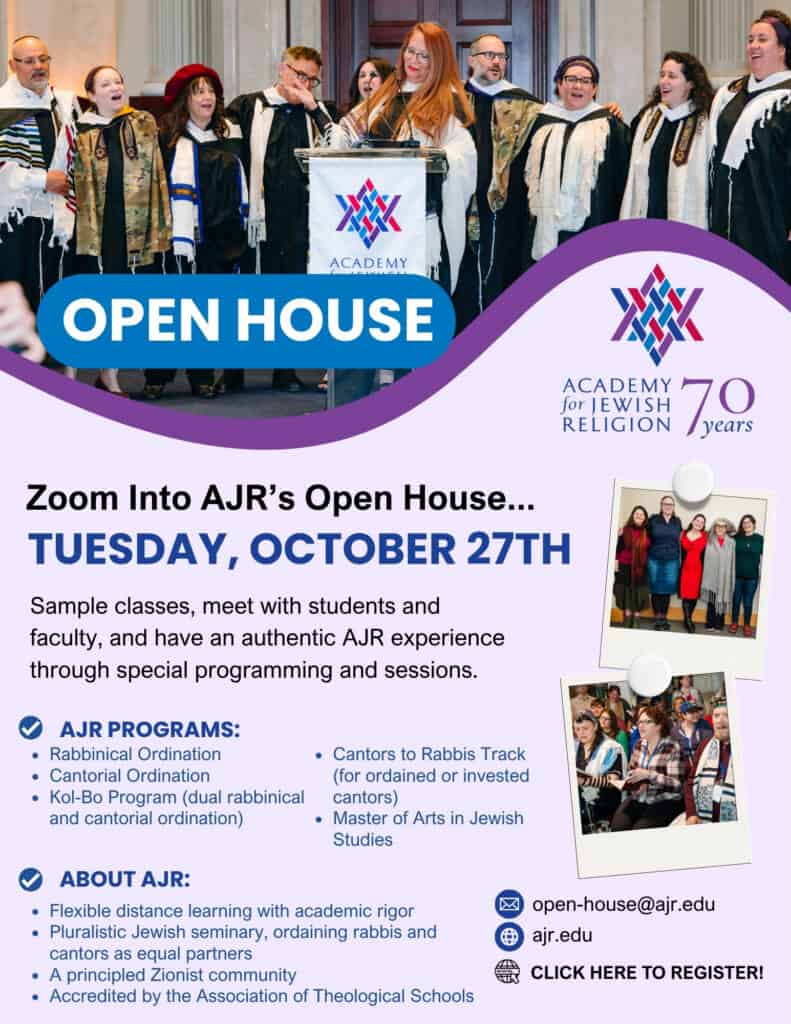
All sessions are on Zoom. Please note that times indicated below are ET.
Tuesday, October 27, 2026
9:15 – 10:30 am – 3 course options
- Advanced Nusah
Cantor Sol Zim - Pirke Avot
Rabbi Jef Segelman - G-d Talk – What Do You Believe?
Rabbi Ira J. Dounn
10:45 – 11:50 am
Informational FAQs
Learn more about our programs of study, curriculum, distance learning, and the AJR application process.
12:00 – 12:45 pm
Getting to Know AJR / Meeting with Students
Meet with current students.
Please feel free to use this time to enjoy your lunch during these conversations.
12:55 – 2:00 pm – 4 course options
- Intro to Talmud II
Rabbi Will Friedman - Advanced Talmud
Rabbi Matthew Goldstone, PhD - Contemporary Midrash
Rabbi Jill Hammer, PhD - Hebrew IB
Ayelet Rein
2:10 – 3:20 pm
Pluralism at AJR and Pluralistic Leadership in Today’s Jewish Community
Dr. Ora Horn Prouser
3:30 – 3:50 pm
Minhah
Experience our spirited tefillot.
3:55 – 5:00 pm – 3 course options
- Thinking with Jonathan Sacks
Dr. Job Jindo - Advanced Nusah
Cantor Lisa Klinger-Kantor - The Kaddish and Its Mysteries
Rabbi Rob Scheinberg, PhD
5:00 – 6:00 pm
Let Us Help You Find Your Place at AJR: Questions About Taking Classes This Fall?
- AJR’s Cantorial Program and Your Place In It
Cantor Michael Kasper - Rabbinic, MA, and Kol-Bo Cantorial and Kol-Bo
Dr. Ora Horn Prouser
Have a great day!
Course Descriptions
Advanced Nusah
Cantor Sol Zim and Cantor Lisa Klinger-Kantor
An in depth, extensive study of the vast Mi-sinai tunes that make up the Rosh Hashanah liturgy. Each student must develop an understanding of the various motifs and nushaot and how to use them in the course of davening.
Pirke Avot
Rabbi Jef Segelman
In this class, we will explore a selection of the mishnayot in Pirkei Avot. Delving deeply into rabbinic, chassidic and modern texts and commentaries, we will focus our attention on how clergy can use this work to evolve our personal theologies and to inspire and strengthen our spiritual leadership.
G-d Talk – What Do You Believe?
Rabbi Ira J. Dounn
An Orthodox rabbi once joked: “To be Jewish means to believe in one G-d…or less.” One of the central tenets in Jewish tradition is monotheism – the belief in a single G-d. And yet, for many of us, belief in G-d is challenging and confusing. In this interactive session, we will delve more deeply into our own beliefs about G-d, and will have the opportunity to get into some big questions about G-d and Jewish theology.
Introduction to Talmud II
Rabbi Will Friedman
In this second half of the two-trimester Introduction to Talmud course, students will continue to develop their skills in decoding the dialectic of the talmudic discourse. This term, the text will be studied in its original languages. Students will prepare the Steinsaltz commentary (Hebrew) with the help of vocabulary sheets provided by the instructor. Modern critical methodologies of Talmud study – identifying the three layers of Tannaitic, Amoraic, and Stam material – will be introduced. Study of basic Aramaic terms and Talmudic organic logic will resume. The content will be the various halakhic and theological approaches to the Amidah found in Tractate Berakhot, chapter 4.
Advanced Talmud
Rabbi Matthew Goldstone, PhD
This course will hone students’ abilities to critically read, parse, and understand Talmudic material that is relevant for understanding contemporary Judaism. This semester will focus on sugyot related to Shabbat practices and prohibitions, which will provide students with a historical and literary understanding of the underpinnings of contemporary Shabbat observances.
Contemporary Midrash
Rabbi Jill Hammer, PhD
In this course, we will explore contemporary poems and stories on biblical characters in English, Hebrew, and Yiddish, as well as some paintings, and discuss how the modern era has brought new forms of Midrash. We’ll consider the biblical texts and rabbinic legends that have informed modern authors, and interpret the messages these new writings convey. We will end the course by creating and sharing our own modern midrashim.
Hebrew IB
Ayelet Rein
Using the second volume of Hebrew from Scratch (‘עברית מן ההתחלה ב), students will read and listen to texts of different genres, surrounding topics of Israeli history and culture, and everyday life. Special attention will be given to writing skills and presentational speaking. Grammatical topics follow lessons 7-13 in the book, and include future tense of various verb groups, preposition inflections, and sentence structures that are used in written language or use future tense.
Thinking with Rabbi Jonathan Sacks: Biblical Tradition, Free Society, and Sacred Responsibility
Dr. Job Jindo
This course offers a critical engagement with R. Jonathan Sacks as an interpreter of biblical and Jewish tradition and as a public religious thinker, with special attention to his To Heal a Fractured World: The Ethics of Responsibility (2005). By the conclusion of the course, students will be able to articulate: (1) central features of Sacks’s interpretation of biblical and Jewish tradition; (2) his understanding of the relationships among autonomy, tradition, covenant, responsibility, and holiness; and (3) ways in which biblical and Jewish sources can illuminate contemporary questions about moral formation, social repair, and sacred responsibility, while also assessing what Sacks’s approach offers and what it may conceal. The course centers on Sacks’s use of biblical tradition, not on the construction of personal theology.
The Kaddish and Its Mysteries
Rabbi Rob Scheinberg, PhD
Why are there so many varieties of the Kaddish? Why is it in Aramaic? Why do mourners say it? What can we learn about the Kaddish from one of the most famous medieval Jewish ghost stories? Join us as we delve into the text and history of one of the most unusual prayers in the siddur.