
Home > Divrei Torah > Parashat Pinhas – 5786
Parashat Pinhas – 5786
June 29, 2026
by Rabbi Kaya Stern-Kaufman
Pinhas in Process
A D’var Torah for Parashat Pinhas
By Rabba Kaya Stern-Kaufman (2011)
This week we are reading a section of Torah named for Pinhas, the grandson of Aaron, who was a zealot for God. His story begins in the previous week’s Torah portion when many of the Israelite men become caught up in sexual relationships with the local Moabite women who enjoined them to worship Baal Peor, a local deity. In response, God sends a plague and thousands of Israelites die. Once again, things are not going well for either God or the Israelites. The Israelites’ fidelity to God is consistently weak and wavering and God responds with consistent wrath and destruction.
In the midst of this chaos, an Israelite man and a Midianite woman begin to have sexual relations in front of the Tent of Meeting. This is the place where Moshe communicates with God; a sacred and intimate space of supreme holiness. Pinhas, outraged, rushes to action and impales them both with a spear. In response, the plague against the Israelites ends as suddenly as it began. Thus ends last week’s parashah but this story is not quite over.
This week’s portion begins as God announces that Pinhas is to be rewarded for his zealotry with an eternal covenant from God, a brit shalom/a covenant of peace and that he is to be the progenitor of the priestly line for all time.
His reward, that he and his children will forever serve God and their community as emissaries of peace, is difficult to understand given the sudden violence of his vigilante actions. Pinhas saw an injustice, made an immediate judgment and executed a death sentence, all in the flash of a moment. God appears to validate his actions by immediately ceasing the plague against the people. God praises Pinhas for expressing his “passion for God” and thereby prevents God from destroying the people through God’s passion. (Numbers 25:11)
The language of the text seems to be saying that God and Pinhas are reflections of each other: a passionate, jealous God and a passionate zealous defender of God.
Our rabbinic tradition struggled with this story through the ages and registered their discomfort in many ways. Two of the most interesting expressions of dissent appear in the way this text is written by every scribe. Every Torah is written the same way, following certain scribal conventions. In this section of Torah, when Pinhas’ name appears in the verse that tells of his great reward, the second letter in his name, the letter yud, is written in a distinctly smaller size than all the other letters in the Torah. This scribal anomaly calls our attention.
To begin to understand this scribal oddity we might first ask the question: what do we know about the letter yud? The yud is the first letter of God’s 4 letter name: Yud – Heh– Vav – Heh. It is taught that the yud represents the seed of Divine energy. It represents the source from which all the other letters emerge. In fact, it is taught that it is the source from which all of Creation emerges. It is shaped like a hand and named for a hand (yud=yad). It represents Divine creative potential.
In our verse, when Pinhas receives the blessing from God of a brit shalom/an eternal covenant of peace, his name contains a diminished yud. It is, as if, the scribal tradition has embedded a protest within the text, recording graphically that despite the heavenly reward, there was a diminution of the Divine aspect within him. This is expressed by the diminished yud in the spelling of his name.
In a related comment on this text, the Netziv, a 19th century Torah scholar from Berlin, states the following:
In reward for turning away the wrath of the Holy One Blessed be He, God blessed Pinhas with the attribute of Shalom, that he should not be quick tempered or angry. Since, as it was only natural that such a deed as Pinhas’, should leave in his heart an intense emotional unrest afterward, the Divine blessing was designed to cope with this situation and promised inner peace and tranquility. ( Ha’amek Davar on Num. 25:12)
In this sense, the blessing of a “covenant of peace” (brit shalom) was not a reward but rather a form of medicine for Pinhas and his descendants to help them deal with the ramifications of their tendency to act violently, out of righteous zeal. The Netziv sees the covenant of peace as a response to the diminishment of the Divine presence in the soul of one such as Pinhas.
Pinhas seems to have quenched the fire of God’s jealous rage and repressed the Israelites’ rebellion against God but his actions carried a cost; not only the loss of life, but a cost to his own soul. Peace is achieved for the moment but it is a limited peace and the perpetrator of this kind of violence emerges spiritually wounded.
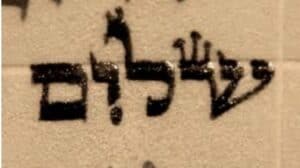
Earlier, I mentioned that there are two expressions of dissent embedded in the text through the scribal tradition. The second scribal oddity appears in the very next verse. The word for peace/shalom in the phrase “covenant of peace” is written in an odd way. The third letter of the hebrew word – the vav– is written with a broken line. A normal vav is a straight vertical line, but this vav is a straight line with a break in the center.
In kabbalistic tradition the shape of the letter vav symbolizes an unbroken link between heaven and earth. Centered in the word for peace/shalom, the vav expresses a connection between heaven and earth, between the spiritual and the physical. Additionally, the word shalom comes from the root shalem, meaning whole. Yet here in our text, Pinhas is awarded a covenant of Peace with a broken letter vav. Literally and figuratively, he is awarded a peace which is not whole. For there to be true peace, both Pinhas and our conception of God, the ‘zealous’ and the ‘jealous’ will need to evolve.
In our midrashic tradition there is a teaching in which Rabbi Shimon ben Lakish states the following:
Pinhas is Eliyahu (Elijah). The Holy One, blessed be God’s Name said, You made peace between Me and the Israelites in this world, therefore in the future you will bring peace between me and the Israelites, as it says: Lo, I will send to you Elijah the prophet … He shall reconcile the hearts of the parents with their children and the hearts of their children with their parents. ( Malachi 3:23-24) ( Midrash Yalkut Shimoni on Book of Numbers/Bamidbar, section 771)
This teaching expresses the idea of reincarnation but also the idea of spiritual evolution. Pinhas will evolve into Elijah, that is, the herald of the Messianic period; a time in which opposing forces will come into a true peace. The most iconic of such images is stated in Isaiah (11:6): The wolf shall dwell with the lamb, and the leopard shall lie down with the young goat, and the calf and the lion and the fattened calf together; and a little child shall lead them.
The midrash seems to say that the broken peace of Pinhas, a peace based on righteous indignation, vengeance and force, can evolve into a true peace, the peace of Elijah, whereby human relationships will be healed. Fundamental relationships torn apart by hatred and fear can and will be reconciled at the level of the heart. Such a teaching should give us strength as well as challenge us to engage in this evolutionary process.
Pinhas is in process! This story exists as a point in time relative to a future vision of a true and enduring peace, in which all will recognize the profound Divine connection that we share. “Bayom hahu yihiyeh Adonai ehad u’sh’mo e had: On that day all will recognize that All is God and All is One. (Zechariah 14:9)
Our world is in process and we, each of us, are in process as well. Our challenge is to progress from the zealousness of Pinhas to the reconciliation between generations offered by Elijah. In these most tumultuous times of violence and righteous vengeance, we are all navigating the emotional terrain of fear, anger, judgement and desire for retribution. We must not get caught here in what is clearly a destructive cycle that is ultimately self-wounding. This moment is not the end of the story. Our prophets held out a different vision; one in which not only do we evolve, but so too does our image of God. The Divine Source is in process from an ancient conception of Jealous Lord to the Divine Eternal Unity of all that is.
Let us take lessons from both Pinhas and Elijah and examine our own attitudes before we speak or act. When we feel the flush of righteous indignation we might ask ourselves whether we are reacting as Pinhas or whether we are motivated by the redemptive energy of Elijah?
Our sacred texts and our sages seem to be teaching that the only way to achieve healing, reconciliation and true peace is when we lay down the sword and open our hearts to speak and listen to one another; when the hearts of the parents are turned toward their children and the hearts of the children are turned to their parents; when ancestral trauma is addressed through intergenerational open-heartedness. Whenever we act with the spirit of Elijah, we build a bridge forward for healing. It is by way of the heart that the vav in the word shalom becomes shalem/whole, that the connection between heaven and earth is restored and a whole and lasting peace is possible.